
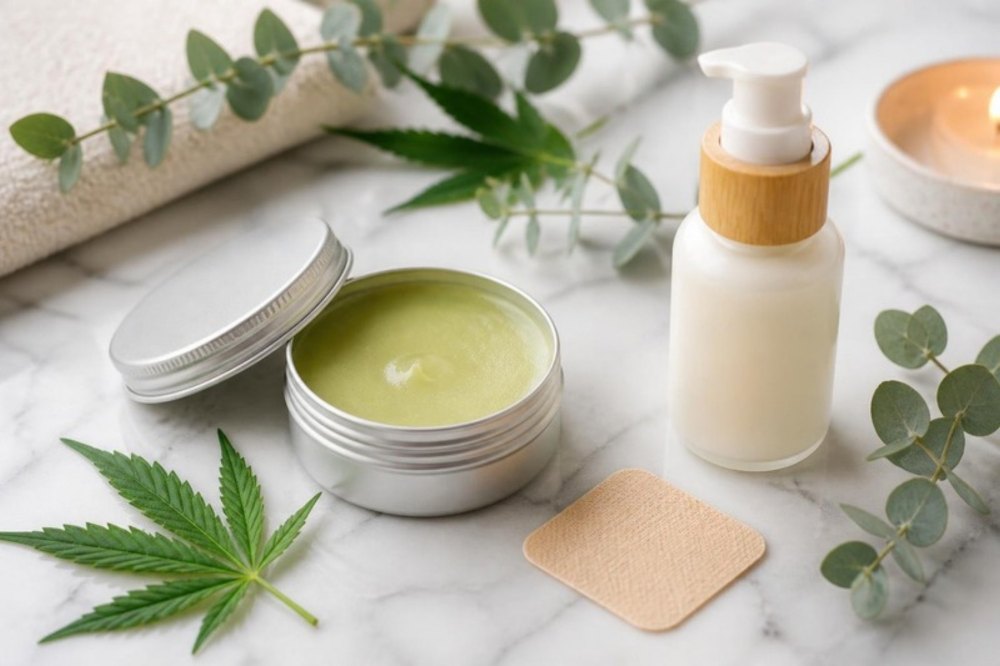
Quick answer: Do cannabis topicals get you high? Ordinary topicals like THC lotions, balms and salves generally don't, because cannabinoids are oily molecules that stay in the outer layers of intact skin instead of reaching your bloodstream in meaningful amounts. Transdermal patches are the exception. They're built to push THC through the skin into circulation, and a THC patch can intoxicate you. Maine labels patches separately for that reason.
Why don't THC lotions and balms get you high?
A THC lotion doesn't get you high because very little THC makes it through your skin into your blood.
THC and CBD are lipophilic: they dissolve in oils and avoid water. The skin's outer layer, the stratum corneum, is a dense, fatty wall with watery tissue underneath. An oily molecule soaks into that top layer and more or less stalls. A 2022 review in Pharmaceutics put cannabinoids' log P (a measure of how oil-loving a molecule is) at roughly 6 to 7, well above the 1 to 3 range typical of drugs that absorb well through skin.
So the THC in a balm mostly stays where you rub it, well short of your brain.
One caveat: this is about intact skin. Broken or freshly shaved skin hasn't been studied well for cannabis products, which is reason enough to skip it.
Do cannabis patches get you high?
Yes, a THC transdermal patch can get you high. Reaching your bloodstream is the whole point of the design. Patches pair cannabinoids with permeation enhancers (ingredients such as ethanol or oleic acid that loosen the skin barrier) and hold them against one spot for hours.
The same review summarizes research in which a delta-8 THC patch held a steady blood level for more than 48 hours. Treat a THC patch like an edible: a real dose that arrives slowly and lasts. Our guide to how long edibles take to kick in covers that patience problem. Peeling a patch off stops most new THC going in, but what's already in your blood still has to wear off, and our page on what to do if you are too high helps there.
Which topical formats reach the bloodstream?
Only patches are built to go systemic. This reflects research and product design, not a guarantee for every brand.
| Format | Reaches bloodstream? | Can intoxicate? | Notes |
|---|---|---|---|
| Lotion or cream | Generally no, small amounts possible | Generally no | Some add permeation enhancers, which changes the math |
| Balm or salve | Generally no | Generally no | Thick, wax-based, stays on the surface |
| Topical oil | Generally no | Generally no | Check the label: some oils are made to be eaten, not rubbed in |
| Transdermal patch or gel | Yes, by design | Yes, with THC | Dose is stated per patch in Maine |
| Bath product (soak, bath bomb) | Very unlikely | Very unlikely | THC is diluted across a whole tub; research is thin |
Bath bombs and soaks
A bath bomb spreads its cannabinoids across dozens of gallons of water, and THC doesn't dissolve in water anyway. There's no good evidence soaking produces a high, or much of anything beyond a nice bath.
Lubricants
Mucous membranes absorb more than elbow skin, so infused intimate oils are the likeliest non-patch format to produce effects, though research is close to nonexistent. Also, oil-based products can weaken latex condoms.
Can cannabis topicals make you fail a drug test?
For ordinary lotions and balms, the limited research says a positive urine or blood test is unlikely. Patches are the main risk, and no cannabis product comes with a guarantee.
In 2017, researchers at the University of Bonn (Hess, Krämer and Madea, Forensic Science International) had three volunteers apply two THC salves over large areas of skin every 2 to 4 hours for three days. All 30 urine and 30 blood samples tested negative for THC and its metabolites. Three people is not a population.
A larger 2024 Johns Hopkins study led by Tory Spindle (Journal of Analytical Toxicology) gave 46 adults hemp-derived CBD topicals with trace THC, used twice daily for up to 10 days. No urine sample hit the federal workplace cutoff. But nine participants, seven of them lotion users, showed THC in oral fluid (a saliva test) above the federal 2 ng/mL threshold, which the authors called unexpected.
Our read: a standard balm is low risk, not zero risk. Assume a THC patch can show up. If your job tests, skip THC products.
THC topicals versus CBD topicals: what's the difference?
THC is the intoxicating cannabinoid and CBD isn't, which is why hemp CBD creams sell at pharmacies while THC topicals need a licensed store. Plenty of products carry both, often 1:1. Read the milligram figures, not the front of the box. Our guide on how to read a Maine cannabis label shows where they sit.
What does the research actually show about topicals?
Topicals are marketed heavily for aches and skin complaints. The research is early and mixed. Lab work shows skin has its own cannabinoid receptors, and there are animal studies and a few small human trials. Large, well-controlled trials of retail products are scarce, and a 2024 scoping review in Pharmaceuticals called for more.
Customers describe a balm as part of a wind-down routine after a long shift or a cold walk around Back Cove. Many also like the menthol or eucalyptus brands add, which makes it hard to know which ingredient they're responding to. If you're thinking about a topical for a health condition, talk to your doctor or a dermatologist first.
How do people use cannabis topicals?
Most people use a lotion or balm like any skin product: a small amount on clean, dry skin, rubbed in. Maine labels must state the recommended amount per use, so start there.
Patch test anything new
The American Academy of Dermatology suggests testing a new skin product on a quarter-sized spot on your inner arm or elbow crease, twice a day for 7 to 10 days. Redness, itching or swelling means stop and rinse. A reaction could come from the cannabis extract or the base (fragrance, essential oils, menthol), and a test spot is how you find out.
Using a patch
Put it on clean, dry, hairless skin where it won't rub, like the inner wrist. Start with the lowest dose you can find, and don't drive: Maine OUI law covers THC from a patch the same as from a joint.
How does Maine label cannabis topicals?
Maine's Office of Cannabis Policy sets the rules in 18-691 CMR chapter 30. Every topical must state total THC and total CBD in milligrams for the container, or per patch for transdermal products, plus a full ingredient list, the recommended amount per use and the warning "For Topical Application - Do Not Eat or Smoke."
Packaging follows the same split. Salves, creams, lotions and balms go in child-resistant containers with a resealing cap. Patches must be heat-sealed in plastic at least four mil thick with no easy-open tab. The state treats patches as the stronger product, which matches the science.
Buying topicals at our Portland shop
Topicals aren't the headline category at our St John Street store, which is better known for its THC beverage selection, so check the online menu before you come in. Our first-time dispensary guide covers ID and the rest.
When comparing jars, ask a Cannabis Guide about the milligrams of THC and CBD, whether the formula uses a permeation enhancer, and what else is in the base. That last one matters more than people think.
Topicals look like hand cream, so lock them up, as our tips for keeping cannabis away from curious kids explain. DIY types often start from our cannabis-infused coconut oil recipe, though homemade potency is a guess. For more low-key options, see our guide to discreet consumption.
Frequently asked questions
Can you get high from THC lotion?
Generally, no. THC is an oily molecule that soaks into the outer layer of intact skin and mostly stays there, so very little reaches your bloodstream or brain. Lotions made with strong permeation enhancers can push more through, so check the ingredient list if you want a product that stays local.
Do THC transdermal patches get you high?
They can. A transdermal patch is designed to move THC through the skin and into your bloodstream over several hours, so its effects can resemble a slow edible. Start with the lowest dose you can find and don't drive. Removing the patch stops most new THC, but what's absorbed still has to wear off.
Will a cannabis topical show up on a drug test?
Limited research, including a 2017 University of Bonn study and a 2024 Johns Hopkins study, suggests ordinary lotions and balms rarely trigger a positive urine or blood test. The Johns Hopkins team did find THC in some saliva samples from lotion users. Patches carry the most risk. If your job tests, avoid THC products.
What is the difference between a topical and a transdermal product?
A topical is meant to stay on and in the skin where you apply it, and it generally doesn't reach your bloodstream in meaningful amounts. A transdermal product, usually a patch, is formulated to cross the skin barrier and enter circulation. Maine requires patches to list THC and CBD per patch and use heat-sealed packaging.
Should I patch test a cannabis topical?
Yes. The American Academy of Dermatology suggests applying a new skin product to a quarter-sized spot on your inner arm or elbow crease twice a day for 7 to 10 days. Stop and rinse if you see redness, itching or swelling, and see a dermatologist if a reaction is severe.
Topicals are the quiet end of cannabis: no smell, no smoke and, in most formats, no high. Patches are the part that deserves respect. If you're curious, see what's in stock on the Rose Mary Jane menu, order ahead, and bring your label questions to the counter.