
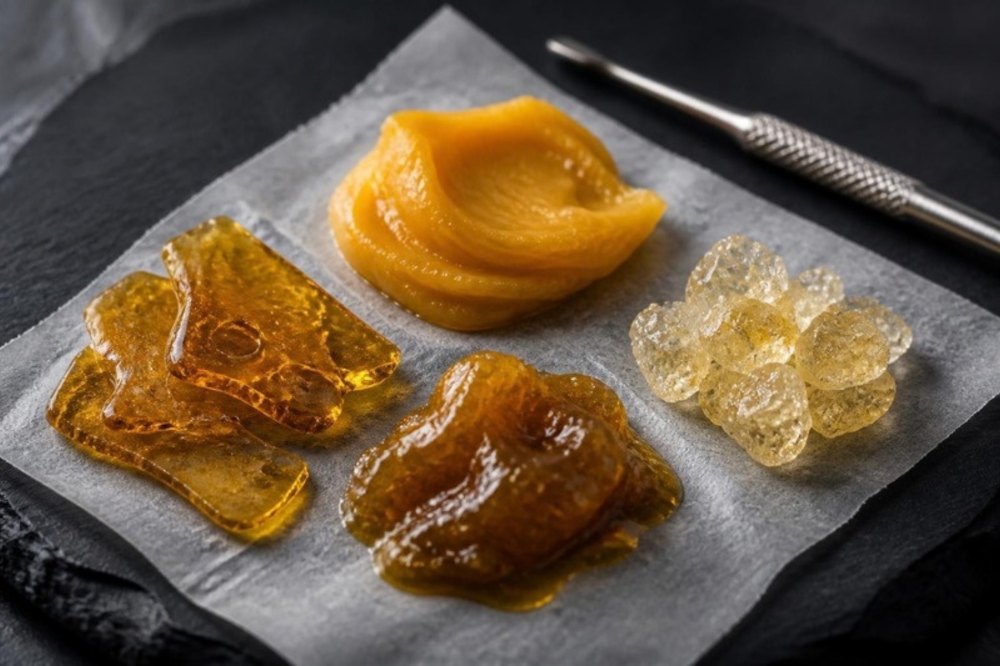
Quick answer: The main types of cannabis concentrates split into two families. Solvent-based extracts (shatter, wax, budder, crumble, sugar, diamonds, sauce, live resin, distillate) use butane, propane, CO2 or ethanol. Solventless ones (kief, hash, bubble hash, rosin, live rosin) use only screens, ice water, heat or pressure. Typical potency runs from about 40% to over 90% THC, and in Maine you can buy up to 10 g per transaction.
Walk up to any concentrate case and the names sound like a bakery that got into chemistry. Budder, sugar, badder, sauce. Underneath, there are only two questions: how the resin came off the plant, and what someone did to it afterward.
What are cannabis concentrates?
Concentrates are products made by separating the resin glands (trichomes) from the plant, keeping the cannabinoids and terpenes and leaving the leaf behind. Flower usually tests around 15% to 30% THC. Most concentrates start well above that.
Maine law treats that gap seriously: of the 2.5 ounces an adult can buy in one transaction, no more than 10 grams can be concentrate (Title 28-B, §1501). Our guide to Maine possession and purchase limits covers the rest of that math.
What is the difference between solvent and solventless concentrates?
Solvent-based concentrates use a chemical (butane, propane, CO2 or ethanol) to dissolve resin out of the plant, then purge that solvent away. Solventless concentrates never touch a chemical solvent. They rely on sifting, ice water, heat and pressure.
Neither family is automatically better. Solventless usually costs more because yields are small, and solvent extraction can reach very high purity. Both can be excellent, and both can be mediocre.
Butane and hydrocarbon (BHO)
Butane hash oil, and its propane cousin, is the source of most shatter, wax, budder, sugar, diamonds, sauce and live resin. Cold hydrocarbon holds onto terpenes well, and the solvent is removed afterward with heat and vacuum.
CO2 and ethanol
Supercritical CO2 uses pressurized carbon dioxide instead of a flammable gas and mostly ends up as runny cartridge oil. Ethanol is the workhorse for big batches, and its crude oil is usually refined into distillate.
Residual solvent testing in Maine
According to the Maine Office of Cannabis Policy, residual solvent testing has been mandatory for adult-use products since October 1, 2021. Kief, hashish and other products made without chemical solvents are exempt from that test. Our guide on how to read a Maine cannabis label shows where the lab results live.
Types of cannabis concentrates compared
Potency figures are typical ranges from industry guides and published lab results, not guarantees. The number on your package is the one that counts.
| Concentrate | Solvent or solventless | Texture | Typical THC range | How people use it | Beginner-friendliness |
|---|---|---|---|---|---|
| Kief | Solventless | Fine, dry powder | About 20% to 60% | Sprinkled on a bowl or joint | High |
| Hash (dry sift, pressed) | Solventless | Soft to firm blocks or crumbles | About 30% to 60% | Topping a bowl, joints | High |
| Bubble hash (ice water hash) | Solventless | Sandy to greasy granules | About 40% to 70% | Topping a bowl, pressing into rosin | Medium to high |
| Rosin | Solventless | Sappy to buttery | About 60% to 80% | Dab rig, e-rig, dab pen | Medium |
| Live rosin | Solventless | Buttery, jammy or sauce-like | About 60% to 80% | Low-temp dabs, e-rig | Medium |
| Shatter | Solvent | Glassy, brittle sheet | About 70% to 90% | Dab rig, e-rig | Medium |
| Wax | Solvent | Soft, sticky, opaque | About 60% to 80% | Dab rig, dab pen, topping a bowl | Medium |
| Budder or badder | Solvent | Creamy, frosting-like | About 60% to 80% | Dab pen, e-rig | Medium to high |
| Crumble | Solvent | Dry, crumbly, honeycomb | About 60% to 90% | Topping a bowl, dab rig | High |
| Sugar | Solvent | Wet, grainy crystals | About 60% to 85% | Dab rig, e-rig | Medium |
| Diamonds and sauce | Solvent | THCA crystals in terpene-rich liquid | Diamonds 90% plus; sauce lower | E-rig, dab rig | Low |
| Live resin | Solvent | Anything from sauce to budder | About 60% to 80% | Dab rig, e-rig, cartridges | Medium |
| Distillate | Solvent, refined | Thick, clear oil | About 85% to 95% | Cartridges, edibles | Low as a dab |
What are the most common concentrate types?
Most solvent concentrates in that table are the same basic extract wearing a different outfit.
Shatter, wax, budder and crumble
Shatter is hydrocarbon extract left undisturbed while it cools, so it sets into a glassy sheet that snaps like toffee. Wax is the same extract whipped during purging until it goes soft and opaque. Budder and badder (two spellings, one product) are whipped longer into something like cake frosting. Crumble is purged longer until it's dry enough to break into honeycomb bits.
Sugar, diamonds and sauce
Sugar is extract where THCA has started crystallizing into wet, sandy grains. Sometimes shatter just sat around and "sugared up." Diamonds are THCA allowed to crystallize slowly into chunky clear crystals, sitting in a runny terpene-rich liquid called sauce. The diamonds carry the THC. The sauce carries the smell.
Live resin, rosin and live rosin
Live resin is hydrocarbon extract made from plants frozen right after harvest. Rosin is resin squeezed out of flower or hash using only heat and pressure. Live rosin is pressed from ice water hash made from fresh-frozen plants, and it's usually the priciest thing in the case.
Kief, hash and bubble hash
Kief is the loose trichome dust that collects in the bottom of a grinder. Hash is kief pressed or worked together. Bubble hash comes from agitating plants in ice water so frozen trichomes snap off, then filtering them through fine mesh bags.
Distillate
Distillate is refined until little but the cannabinoid remains, with terpenes often added back, and it fills many cartridges. Disposable vapes and full-extract oils like FECO and RSO are separate topics for another day.
Does texture affect potency?
Mostly, no. Texture comes from post-processing: how the extract is purged, whether it's whipped, how warm it gets and whether THCA crystallizes. Shatter and wax from the same run can land within a few points of each other.
Shatter isn't "stronger" than budder because it looks more serious. Diamonds are the real exception, since crystallization concentrates THCA and pushes terpenes into the sauce. Otherwise, read the lab number and treat texture as a handling preference.
What is the difference between live and cured concentrates?
"Live" means the plants were frozen fresh at harvest and extracted frozen. "Cured" means the plants were dried and cured first, the way flower is. Live products usually keep more of the plant's original terpenes, so they smell brighter.
Drying and curing take days to weeks, and the most volatile aromatics evaporate along the way. Freezing skips that, at a cost, since cold storage isn't cheap. Cured products tend to taste deeper and more like a jar of flower. Live ones often lean fruitier and louder. If terpenes are what you're chasing, our terpenes 101 post on myrcene is a decent place to start.
Neither is stronger by default. "Live" describes aroma and process, not THC.
How do you use cannabis concentrates?
Most concentrates are vaporized on a hot surface (dabbing) or sprinkled onto flower. Dabbing happens on a rig, an e-rig or a dab pen.
-
Dab rig: a glass water pipe with a banger you heat with a torch. Real learning curve, open flame. Most people overheat it at first, which burns off flavor and hits harder.
-
E-rig: heats itself to set temperatures, so it's easier and more repeatable. Lower settings are gentler on terpenes.
-
Dab pen: a pocket battery with a small chamber. Budder and sauce load easily, though small chambers can run hot.
-
Topping a bowl or joint: kief, hash or crumble on flower. The old-school route, and no new gear.
Which concentrate should a beginner try first?
For most first-timers, a little kief or hash on top of a bowl is the gentlest start, followed by a budder or crumble on an e-rig at a low setting. Skip diamonds and distillate dabs until you know how you react.
A few rules of thumb from behind our counter:
-
Pick something you can portion easily. Shatter can fling shards across the table.
-
Choose a lower number, not a higher one. A 65% rosin is not a lesser product than a 90% distillate. It's a more forgiving one.
-
Buy a half gram if you can. You don't need a full gram to find out.
How much concentrate should you take?
Start with a piece about the size of a grain of rice, or smaller, then wait at least 10 to 15 minutes before taking more. Vaporized concentrates hit fast, and the second dab taken too soon is how most bad nights start.
Go smaller still if you usually take a few puffs of a joint, and don't stack an edible on top. If it gets to be too much, our guide on what to do if you're too high walks you through it. Anyone with health questions about THC should talk with a healthcare provider first.
And never drive after dabbing. Maine treats cannabis impairment as OUI.
How do you store cannabis concentrates?
Store concentrates in an airtight silicone or glass container, away from heat and light, somewhere cool and dry. Heat drives off terpenes, light degrades cannabinoids and air changes texture. Shatter left near a sunny window won't stay shatter.
Live products and sauces keep best refrigerated in a sealed jar. If you do, let the jar reach room temperature before opening so condensation doesn't form inside. Keep everything in its child-resistant packaging and out of reach, because a tiny jar of 80% THC is a far bigger risk to a curious kid than flower. Our tips to safeguard your stash from curious kids apply double here.
Can you make concentrates at home in Maine?
Not with butane or other flammable solvents. Title 28-B, §1503 bars anyone outside a licensed operation from making cannabis concentrate with an "inherently hazardous substance," and it's also illegal to knowingly let someone do it on your property. Amateur butane extraction has a long record of fires and explosions, which is exactly why.
Sifting kief or pressing rosin with heat uses no hazardous solvent. If you grow your own six mature plants (see can you grow cannabis at home in Maine), that's the lane to stay in.
Shopping for concentrates on St John Street
Concentrate shopping at our Portland shop on St John Street usually starts with one question from a Cannabis Guide: how do you plan to use it? A bowl-topper gets pointed toward kief or hash. An e-rig owner might hear about budder or live rosin. Someone brand new often leaves with a half gram and a promise to go slow.
We prioritize lab-tested products from women-owned, LGBTQ+, BIPOC and social equity brands, so ask who made what you're holding.
Frequently asked questions
Is shatter stronger than wax?
Not in any reliable way. Shatter and wax usually come from the same kind of hydrocarbon extract, and the texture difference comes from post-processing: shatter cools undisturbed, while wax is whipped. Potency from the same run tends to land within a few points, so read the lab number on the package instead of judging by looks.
What is the difference between live resin and live rosin?
Both start with plants frozen fresh at harvest. Live resin is extracted with a hydrocarbon solvent such as butane, then purged. Live rosin uses no solvent: the frozen plants are washed in ice water to make bubble hash, which is then pressed with heat and pressure. Live rosin usually costs more because yields are smaller.
What concentrate is best for beginners?
Kief or hash sprinkled on a bowl is the gentlest first step, since it needs no new gear and usually tests lower than dab products. If you want to try dabbing, budder or crumble on an e-rig at a low setting is forgiving. Start with a rice-grain-sized amount and wait before taking more.
How much concentrate can you buy in Maine?
Under Title 28-B, section 1501, an adult 21 or older can buy up to 2.5 ounces of cannabis per transaction, and no more than 10 grams of that can be concentrate. The concentrate limit rose from 5 grams to 10 grams effective October 25, 2023. Possession and gifting follow the same limits.
Are solventless concentrates safer than solvent concentrates?
Not automatically. In Maine, solvent-based products have faced mandatory residual solvent testing since October 1, 2021, and a failed batch must be remediated and retested or destroyed. Solventless products skip that one test because no chemical solvent is used. Both still go through potency, contaminant and microbial testing.
Picking your first jar
Most people only need two facts to shop with confidence: which family a concentrate comes from, and what number is on the label. Texture is a comfort choice, "live" is about aroma, and a rice-grain dose is plenty to start. Browse what's in the case today on our online menu, order ahead for pickup, and bring your questions to the counter.