
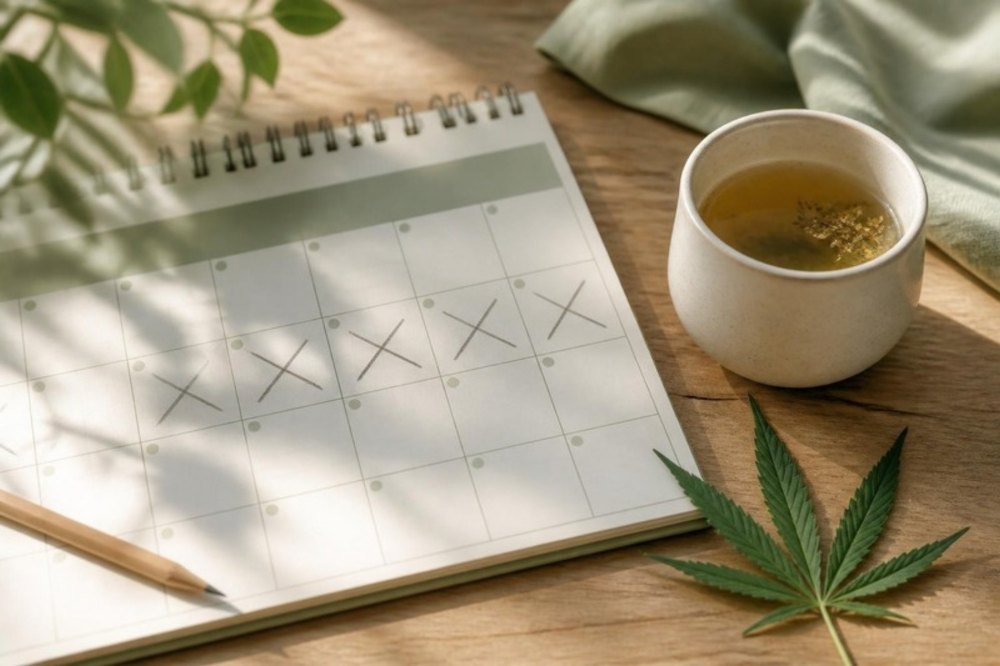
Quick answer: To take a tolerance break, stop using THC completely for a set stretch, then come back at a much lower dose. For occasional users, 48 hours to a week often does it. Daily users usually need 2 to 4 weeks. Brain imaging from Yale in 2016 found cannabinoid receptor availability in heavy users had begun rebounding after just 2 days without cannabis.
Nobody has run the perfect study on this. There are a handful of small brain scans, decades of research on what stopping feels like, and a lot of people online quoting "21 days" as if it came down from a mountain.
Why does THC tolerance build in the first place?
Tolerance builds because your brain adapts to regular THC by dialing down its CB1 receptors, the main sites THC acts on. Fewer available receptors means less effect from the same dose, and a tolerance break (a T-break, on the forums) is a planned pause that lets them recover.
The gummy that used to carry your whole Saturday barely registers, so you take two. Then two stops working, and your spending climbs with it.
The adaptation is measurable. In 2012, a National Institutes of Health team led by Jussi Hirvonen published PET scans in Molecular Psychiatry showing that chronic daily cannabis smokers had fewer CB1 receptors in cortical brain regions than non-users, and the drop tracked with years of smoking. After about four weeks of supervised abstinence, receptor levels were back in the normal range.
How long should a tolerance break be?
Long enough to match how much you use. Two days can make a real difference for someone who uses a few times a week, while daily users usually see the fullest reset between two and four weeks.
The fast part comes from a 2016 study in Biological Psychiatry: Cognitive Neuroscience and Neuroimaging by Deepak Cyril D'Souza and colleagues at Yale. They scanned 11 men who met criteria for cannabis dependence. At the start, their CB1 receptor availability ran about 15 percent below healthy controls. After just 2 days of monitored abstinence, the difference was no longer statistically significant, and it stayed that way at 28 days.
Keep the caveats in your pocket. Both studies were small and scanned men only. A receptor scan isn't the same thing as how high you feel on a Friday. Treat the table as a starting point, not a prescription.
| Break length | What the research suggests changes | Who it tends to suit |
|---|---|---|
| 48 hours | Receptor availability in heavy users had started to rebound in the D'Souza scans. Temporary effects from stopping often begin here for daily users. | Weekend or few-times-a-week users whose sessions feel a bit flat |
| 1 week | You're past days 2 to 5, when stopping usually feels hardest. Sleep may still be off. | Near-daily users who want a noticeable reset without a long commitment |
| 2 weeks | For most people, the effects of stopping have eased or cleared, and tolerance has likely dropped a lot. | Daily users and people who use several times a day |
| 3 to 4 weeks | Close to the roughly four-week point where Hirvonen's group saw receptor levels back in the normal range. | Long-term heavy users, concentrate users, anyone wanting the fullest reset the research describes |
One humbling data point. A 2023 study of 170 young adults in Drug and Alcohol Dependence, led by Emily Ansell, found that tolerance breaks averaged about 2.5 weeks and weren't linked to lower use afterward. Breaks taken for other reasons, like work or money, lasted longer and were. Come back with a plan.
What happens when you stop after heavy use?
If you've used daily for months, expect some temporary effects: trouble sleeping, irritability, restlessness, a smaller appetite and unusually vivid dreams. They usually start within a day or two, peak around days 2 to 5, and fade within two to three weeks.
That timeline comes from a 2017 review by Nicolas Schlienz and colleagues in Current Addiction Reports, which also noted that sleep changes can linger longer than the rest. The dreams catch people off guard. Plenty of regular users barely remember dreaming, and then around night three the full cinema comes back, with plots.
It's real, and it's not a character flaw. If stopping is harder than you expected, talk to your healthcare provider. SAMHSA's National Helpline at 1-800-662-4357 is free, confidential and open 24 hours a day.
A day-by-day plan for a two-week break
Pick a start date, clear out temptations, expect days 2 to 5 to be grumpy, and fill your evenings on purpose. Stretch or shorten it to match your row in the table.
Day 0: set it up
Choose a quiet week, not the night before a deadline. Put your products out of sight, locked up ideally. Tell one person. Write your reason on a sticky note. "Spending less" is a good one. So is "I miss when one pre-roll did the job."
Days 1 to 3: the wobble
Sleep usually goes first. Cut caffeine after noon, get daylight, and move. A long walk along the Eastern Promenade counts. If your ritual was a porch session, keep the porch and swap what's in your hand: seltzer, tea, or a recipe from our THC mocktails for Dry January post with the THC left out.
Days 4 to 7: ride out the peak
Plan something for the hour you used to use. Cook something slow. Call a friend. Go to bed a bit earlier and don't panic if sleep is patchy. Warn the people you live with about the irritability.
Days 8 to 14: the fog lifts
Appetite returns, dreams calm down, mornings get clearer. Use this stretch to decide how you want to use cannabis when you come back, while you're thinking about it sober.
Can you cut back instead of stopping completely?
Yes, and for plenty of people it's the better fit. Cutting back won't reset tolerance as fully or as fast as a full break, but lowering your dose and frequency slows the climb and is easier to stick with. The research here is thin, so this is counter experience rather than science.
Use fewer sessions
Drop from every night to three nights a week, or keep weekdays clear. Fewer sessions, fewer chances for your receptors to adapt. Cheaper, too.
Switch to lower-dose products
A gram of 28 percent flower is a lot of THC. A half-gram pre-roll, lower-potency flower, or one vape pull instead of five all bring the dose down. Our guide on how to read a Maine cannabis label shows how to turn percentages into milligrams.
Try a 2.5 mg drink
A 2.5 mg can lets you set a small, exact amount and stop there, and drinks tend to come on faster than edibles, as we explain in how long THC drinks take to kick in. Some people call a routine of tiny doses "microdosing." The term is loose and the research is early. The plain benefit is that you know exactly how much you had.
How do you come back after a tolerance break without overdoing it?
Start with a quarter to a half of your old dose and wait longer than you think you need to. Your tolerance has dropped, so your pre-break amount can feel much stronger than you remember.
It's the most common mistake we see: celebrating two clean weeks with the same heavy session that sent you on the break. Then you're on the couch reading what to do if you're too high.
For the first week back:
-
With flower or vapes, take one or two small puffs and wait 15 minutes.
-
With edibles, start at 2.5 mg and give it the full wait. Our piece on how long edibles take to kick in explains why two hours isn't overcautious.
-
Skip concentrates for now. They'll still be there next month.
-
Decide your new baseline before the first session, not during it.
Coming off a break at Rose Mary Jane
Tell a Cannabis Guide at our St John Street shop you're coming off a break and they'll point you to lower-dose options rather than the strongest jar on the shelf. We hear it most weeks, and nobody will raise an eyebrow.
Our menu is sorted by how you want to feel, so if your routine lived in Unwind, stay there and pick smaller. Most returning customers start in our THC beverage cooler, because a 2.5 mg can is about as easy to dose as anything we sell. If spending less was part of the point, check our current deals and the Amplify loyalty program. Or just stop by the Portland shop at 327 St John St, open daily 8:30am to 10pm, and talk it through.
Frequently asked questions
How long does it take for THC tolerance to go down?
It starts dropping quickly. In a 2016 Yale brain imaging study, heavy users' cannabinoid receptor availability had begun rebounding after just 2 days without cannabis, and a 2012 study found receptor levels back in the normal range after about four weeks. Most occasional users notice a difference within a few days to a week, while daily users usually need two to four weeks.
Is a 48 hour tolerance break worth it?
For light and moderate users, yes. Two days is enough for many people who use a few times a week to notice that a smaller amount goes further. The 2016 D'Souza study also found early receptor changes in heavy users within that window. If you use every day, 48 hours helps a little, but a week or two usually does far more.
Why is 21 days so often recommended for a T-break?
Three weeks became a rule of thumb in college wellness guides and online forums, and it's a reasonable middle ground. It lands after the temporary effects of stopping usually fade and shortly before the roughly four-week point where research saw receptor levels back to normal. No study has shown that 21 days is a magic number, though.
What are the side effects of taking a tolerance break?
If you've been using heavily, you may notice trouble sleeping, irritability, restlessness, a smaller appetite and vivid dreams. These typically start within a day or two, peak around days 2 to 5 and fade within two to three weeks, though sleep can take longer. If stopping feels harder than you expected, talk to your healthcare provider.
How much should I take after a tolerance break?
Start with about a quarter to half of what you used before the break, and wait longer than usual before taking more. For edibles or drinks, 2.5 mg is a sensible first dose. Your tolerance has dropped, so your old amount could feel much stronger than you remember. Build back up slowly over a few sessions.
Before you go
A tolerance break isn't a verdict on your habits. It's maintenance, like tuning your skis before the season. Pick a length that fits your use, expect a grumpy few days if you've been at it daily, and come back low and slow. When you're ready, browse the Rose Mary Jane online menu for low-dose drinks and smaller pre-rolls, and order ahead for pickup on St John Street.